Artistic Director
Alvin Youngblood Hart’s first time as a teaching artist at Centrum’s then titled ‘Country Blues’ workshop was in 1995, the program’s third year running. Alvin has taught at the program seven times since. Over the course of its years, the program, started by Centrum program manager Peter McCracken, has had five Artistic Directors. After the first years on his own, Peter began to work with Phil Wiggins as Artistic Director and continued for many years. Later he worked with Dr. Corey Harris for a few years. In 2013, Mary Hilts took on management of the program and worked with Daryl Davis, Jerron Paxton and most recently, Jontavious Willis as Artistic Directors. Alvin Youngblood Hart accepted Artistic Directorship of Centrum’s now titled Traditional Blues program beginning in 2027. All of us at Centrum could not be more thrilled to present Alvin’s vision for the Traditional Blues program.

Artist Faculty
2027 Artist Faculty to be announced soon - 2026 Artist Faculty listed below:




Workshop
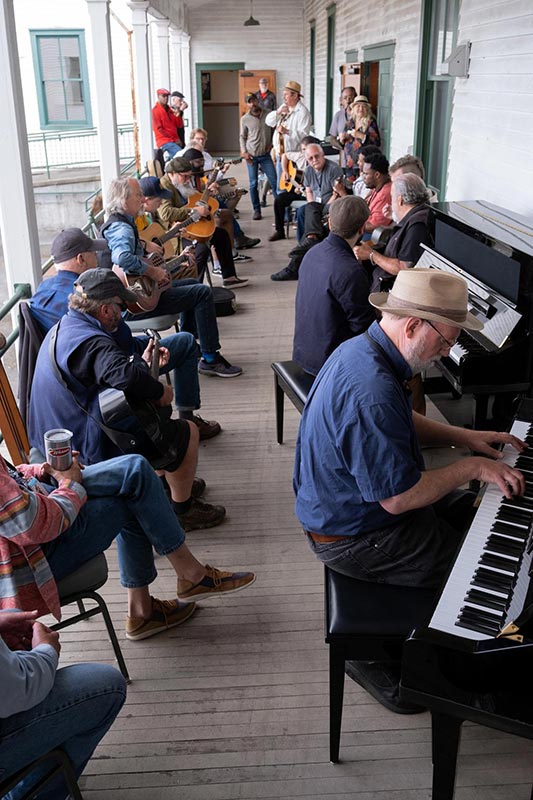
Participants learn “knee-to-knee,” in intimate sessions with diverse instruments and artist faculty. Daily classroom instruction covers traditional blues, performance, history, songs, and styles, as well as technical skills and how to play well with others. Afternoons include discussions on relative topics. Each evening, participants enjoy faculty concerts, chats, jam sessions, and house parties.
Most artist faculty teach two one-hour instrument sessions daily. Sessions are in various styles and techniques and focus on certain traditional methods. Instrumentation includes guitar, harmonica, piano, mandolin, violin, bass, banjo, ukulele, washboard, voice, steel guitar and accordion. Classes are also offered in performance, improv, ensembles, and a gospel choir that gathers in the afternoon.
FIRST DAY:
4–5:30pm – Check-in, Centrum office
6–8pm – Dinner
8pm – Orientation
TUESDAY-FRIDAY:
Most artist faculty teach two one-hour instrument sessions daily, Tuesday through Friday. Sessions in various styles and techniques focus on certain styles and tradition bearers. Instrumentation includes guitar, harmonica, piano, mandolin, violin, bass, banjo, ukulele, washboard, voice, and accordion. The Gospel Choir gathers late afternoons. Evenings include events and performances, planned and spontaneous jams.
FESTIVAL
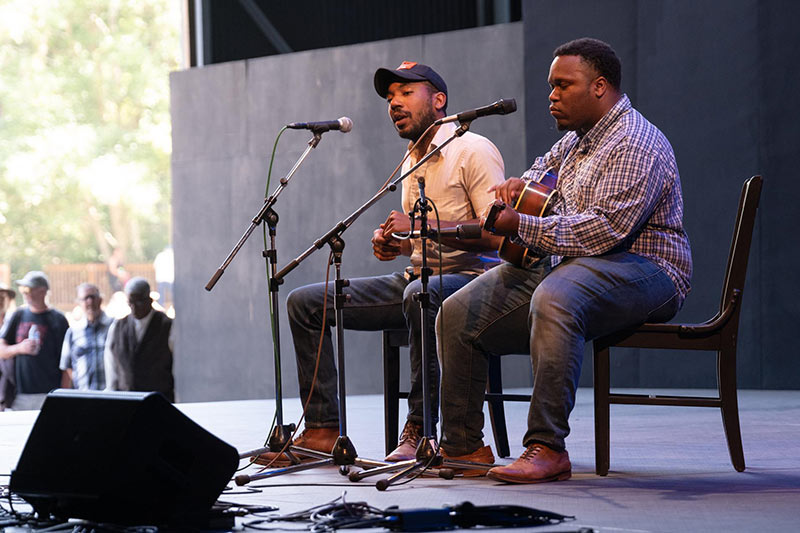
At the end of the week, the artist faculty take to the stages and share in performance a festive celebration of the traditions they carry as well as their own music and style. Friday and Saturday nights, our legendary Blues in the Clubs series hosts a variety of intimate stages, where each artist gives their own unique performance. We’ll host a show or two in McCurdy Pavilion, a former blimp hanger turned performance space, break bread together, and have a really good time basking in and soaking up the traditions passed along at the gathering.
Gospel Choir
CENTRUM Traditional Blues GOSPEL CHOIR 2026
Lloyd Buchanan and Chris Wallace return to direct Centrum's Gospel Choir. Both gentlemen are musical directors of their respective Baptist churches in Georgia, USA. We were very honored to host these gentlemen and thrilled to hear the sounds of your voices in concert after a week under their direction!
You can take the Gospel Choir track exclusively and receive admission to the gospel class Tuesday through Friday, and all evenings in Building 204, through Thursday. The choir performs on Saturday at the USO Hall. Gospel tuition includes admission to the Saturday afternoon mainstage concert and Wednesday dance at the McCurdy Pavilion. Gospel tuition does NOT include Blues in the Clubs or other public events.
Gospel Choir is available for youth however, anyone under the age of 18 must attend with a registered participant or registered guardian over the age of 21. Registered Traditional Blues participants can participate in the Gospel Choir at no additional fee.
In 2026, the Gospel Choir will meet daily starting Tuesday, July 28 through Friday, July 31 from 3:00pm to 5:00pm in the USO Hall and perform at 11:00am on Saturday, August 1 at 11:00am in the USO Hall.
Join us and lift your voices on high!
CLASS DESCRIPTIONS
2026 Traditional Blues Class Descriptions
Rodrigo Mantovani - Upright Bass for Country Blues
This course focuses on the essential techniques and musical concepts needed to play upright bass in traditional country blues and early acoustic blues styles. Through practical examples and listening, students will learn how to create solid, driving bass lines that support the groove, and spirit of the music.
Topics covered include:
- Right-hand techniques, including traditional plucking and slap bass.
- Developing time and groove, in two-beat, shuffle, and walking feels.
- Ear training for blues bass players: learning to recognize chord changes, bass movements, and traditional patterns by listening.
- Common blues song structures, including 12-bar blues, 8-bar forms, and variations used in country blues.
- Building bass lines that support singers and guitar players.
- Dynamics and tone production on the upright bass.
- Listening and stylistic analysis of classic country blues and early acoustic blues recordings.
- Playing in acoustic ensembles, learning how the bass interacts with guitar, harmonica, and vocals.
Damon and Kelsy Stone - Blues Dance
- Good Time Tonight
Blues music was the party music of its time, and the idiom and freestyle dances were the accompanying party dances. We'll work on how to channel that party vibe in our dancing and learn how to get out of heads and let the music move us.
- The Slow Drag
The first known and most versatile social partnered dance to Blues music, the Slow Drag, was done from New Orleans to Chicago, from New York to Los Angeles, from the late 19th century to nightclubs and bars today. We'll go over the most basic elements that define the dance and explore how it changes from place to place and from decade to decade.
- The Dances of the Jook Joints: Knees and Hips
Jook Joints were Black social centers originating in the rural South. The place to be for filling food, cheap drinks, a card or dice game, camaraderie, companionship, and music; jook joints were also a hotbed of innovation for dancing. In this class we'll look specifically to the hip and knee centric dances like, the Mooche, Grind, Fish Tail, and Knee Rock.
- The Dances of the Jook Joints: Fancy Feet
Jook Joints were Black social centers originating in the rural South. The place to be for filling food, cheap drinks, a card or dice game, camaraderie, companionship, and music; jook joints were also a hotbed of innovation for dancing. In this class we'll look specifically to the foot centric dances like, Tick-Tocks, Heel-Toe, Shuffle, Camel Walk, and Sand.
- Barrelhouse, Stride and Boogie
Rolling rhythms, light-hearted playfulness, and thunderous jams- this class will focus on footwork, internal rhythms and, always staying cool as we dance to Pinetop's piano blues.
- Cross Road: Blues Fundamentals
Blues dances as an improvisational folk-art form depend on a shared set of value-based rules that define the grammar and vocabulary of the language of Blues movement. In this class we'll teach the rules that will give you a foundation to build your Blues dances upon.
- Memphis Movement
This class will focus heavily on the dances popular on and off Beale St. We'll cover how the Black urban residents of Memphis and the Black rural residents of its outlying areas shared music and movement from jook joints to backroom clubs and some of the styles of dances that came out of this cross-pollination.
Ricky Nye – Blues Piano
Fundamentals of Boogie Woogie, left-hand patterns and right-hand vocabulary; Blues piano building blocks. Insight into New Orleans style approach to piano. Nuts and bolts approach to music theory. Historical information and stories provided as part of the experience. Ricky encourages attendees to bring a notebook, and to make video clips to study afterwords. Ricky welcomes attendees to email him if they'd like to touch base ahead of time rickynyepiano@gmail.com
Mark Puryear - Blues Improvisation Techniques
The sessions will explore techniques and skills for blues improvisation. Employing select blues forms including 8 and 12 bar blues, participants will explore the importance of phrasing, timing and rhythmic accuracy to develop improvisational skills useful in refining one's playing and jamming ability. The sessions will focus on active listening and playing with other musicians. And sessions will focus on expanding the participant's melodic, harmonic and rhythmic ear. When talking, we use pitch, tone, and rhythm fluidly to enhance our verbal communication. With practice, improvising, in traditional blues music, one can employ similar techniques to develop a personal style. Appropriate for all instruments at the advanced beginner to intermediate level.
Lightnin’ Wells - Ukulele Techniques
In this class we will deal more with techniques to improve or add new tricks to your ukulele skills. Again, ukes should be tuned in the C tuning (G-C-E-A). We will cover various strumming techniques associated with the uke including the basic strum, the double strum and the triple strum as well as sliding to chords. We will introduce finger picking and teach an exercise to make this technique familiar and adapt it to fit in every key. Introductions and outros introduced by past uke master’s as Roy Smeck and Johnny Marvin will be taught in the key of F and we will employ its use in several uke tunes. We will also learn several vintage uke tunes from the roaring 20s to help demonstrate how these ukulele techniques can be put, to use. Finally, an entertaining as well as instructional film compilation of ukulele players dating back to the 1920s will be presented where we can observe first-hand how it was done in years gone by.
Lightnin’ Wells - Vintage Tunes for the Uke
In this class, we will be dealing with the mainland style of uke which was made popular during the jazz age during the 1920s. Ukes (soprano, concert or tenor) tuned in the C tuning (G-C-E-A) are OK for this class; baritones are not. We will learn some ageless tunes mostly from the 1920s from the time when uke was king in America. Examples may include:
- Love Songs for the Uke (It Had to Be You – Sweet Someone – Baby Face – A Garden in the Rain – ‘Deed I Do – Ain’t Misbehavin’)
- Blues Songs for the Uke (The Blues Ain’t Nothin’ – ‘Lassas Blues – Crazy Blues – Waitin’ for the Evening Mail – Am I Blue? – Sweet Georgia Brown)
- 1920s Songs About the Ukulele (Ukulele Lady – Ukulele Baby – Crazy Words, Crazy Tune – Oh, How She Could Play a Ukulele)
- Novelty Songs for the Ukulele (It Ain’t Gonna Rain No Mo’ – Who Takes Care Of The Caretaker’s Daughter – Old Uncle Bill – Doodle Doo Doo – Insufficient Sweetie)
Handouts will include revised vintage sheet music sheets with lyrics and chords, making it easy to learn these pieces and take home for further practice and enjoyment. Different songs will be taught each day.
Jason Ricci - Harmonica
Open to all ability levels, recording, photographing and note taking are strongly encouraged and recommended. Participants are encouraged to bring recording devices, note pads and at least one harmonica in the key of C. If there are things you don't understand, these recordings and notes together may be very valuable later as you progress. Interactive classes will focus on the following topics (no prerequisite music theory is needed). We will learn as we go.
I: Playing Alone (Being your own Band)
- A.) Tone, achieving single notes, embouchure, rhythm, bending and overblows.
- B.) Root notes, what are they, why are they important? Understanding 12 bar blues structure with three simple root notes. Timing and phrasing to be able to jam, with yourself in a basic simple structured form with just a few notes.
- C.) Listening, incorporating licks/riffs into improvisation and the importance of playing without and learning what the band is doing. Understanding blues as a language.
- D.) Developing practice routines.
- D.1:) Music as a way of life regardless, if you are a hobbyist or inspiring professional. K. Anders Erikson and Deliberate Focused Practice.
II: Basic Harmony (Chords and More)
- A.) Scales. Major Pentatonic, Minor Pentatonic, Blues and more. The difference between major and minor music, cords and scales.
- A.1:) What's important about learning and practicing scales? How to practice them. Where and when to use them and how.
- A.2:) Scale Exercises: Breathing, Patterns, International and more.
- B.) Major Triads and 6th and 7th Chord Arpeggio and more.
- C.) Minor Chords and how to play them.
- D.) Approach Tones, enclosures, chromaticism and very basic jazz improvisational approaches to blues improvisation.
III: Harmonica Positions.
* 1st Position / * 2nd Position / * 3rd Position / * 4th Position / * 5th Position / * 12th Position
IV: What are modes and modal Playing?
- A.) How do modes relate to harmonica positions and do they have to?
- B.) Modes as scales or hacks/shortcuts to harmony and choosing them for different music.
- C.) Harmony and Modes together!
V: Playing with a band or duo.
- A.) Comping or leaving spaces with singers, respect, listening and etiquette.
- B.) Gear and more. What do I or don't I need to jam or join a band:
- B.1:) Microphone
- B.2:) Pedals
- B.3:) Amplifiers
- C.) Busking
* Q & A is encouraged THROUGH OUT and students are ENCOURAGED to interrupt with raised hands and any questions at ANY time in any of the presentations. I’m Italian from a NYC Italian family I’ll ask if there are questions, but interrupting is GOOD and not an interruption just a further clarification to whatever subject we're on.
Mara Kaye - Sourcing from The Well: A Storyteller's Guide to Singing the Blues
Through the brave and transformative act of singing, students will learn how to connect to the stories of the songs they love and free their voices in the process. We will be using the works of some of the greatest traditional blues singers as our guide to explore the richness and depth of storytelling through song, phrasing, lyric coloring and space. These classes encourage singers to dig deep into their well, to find their own voice, love their own voice, and sing the stories of their soul with a grounded sense of connection.
Singing has shown us to improve our health and happiness. An experience of expression that not only brings us closer to our own pathway to joy but sharing the experience of singing together as a group creates an increased sense of community and belonging.
Students should come prepared with a blues song of their choosing that they feel connected to work on in class. Live guitar accompaniment by Tim McNalley
Eleanor Ellis - Acoustic Blues Repertoire
One reason I'm drawn to old-time acoustic blues is because no matter what the song or who the musician, you can almost always find something unique or peculiar or interesting going on, whether in the subject matter, the structure of the song, the guitar accompaniment, the style of the singer or a combination of the above. We'll find and learn some interesting songs from the acoustic country blues tradition, songs which you can play as is or adapt to your own style and make your own.
Eleanor Ellis – Blues Guitar in Dropped D Tuning
Alternate tunings can be a useful way to get fresh ideas for arrangements, voicings, and sounds on the guitar, and this simple tuning has been used by many blues musicians and works well with many styles of music. We'll begin with an overview of the tuning - basic chords, turnarounds, intros etc. and will put these elements together to learn songs from musicians such as Tommy Johnson, Ragtime Henry Thomas, Pink Anderson etc.
Andrew Alli – Beginning Blues Harmonica
Getting going with the basics. This class focuses on establishing good harp habits and approaches without being overwhelmed. Key of C and A harp.
Andrew Alli – Intermediate Blues Harmonica
Meat and Potatoes: Thickening up your sound with layers and technique. Key of A harp
George Aschmann – Blues Violin
The blues violin course will be a three-part workshop focusing on blues fiddle tunes, song melody playing, and improvisation. We will be flexible in how much time we spend on each of these subjects depending on the interests and levels of participants.
- Blues fiddle tunes
Learn one or several tunes that fall into the “blues” style of fiddling, focus on styles, technique, note choice, and variations-introducing the idea of micro improvisation
- Song and melody playing
Learn the melody to a song from the 1920s/30s, learn to back up a vocalist, solo around the melody-also micro improvisation. Think Mississippi Sheiks style…
- Improvisation
If there is time at the end of the week and students are interested, we will continue to build on the idea of micro improvisation and move toward improvising in a Blues-oriented style over songs that allow more freedom…a blues progression or simple jazz tune in the 1920/30s style.
Sunpie Barnes – Accordion
Sunpie will teach his unique mixture of zydeco, Blues, gospel, jazz, and African and Afro-Caribbean music into a musical gumbo that he dubbed “Afro-Louisiana” music.
Clinton Davis – Ragtime Guitar
Ragtime guitar, both classic and barrelhouse styles, from players like Pink Anderson, Blind Blake, Willie McTell, and Luke Jordan.
Clinton Davis – Blues Banjo
Incorporating standard blues ideas, such as turnarounds, intros, and endings. Use of 7th chords, 12-measure rhythm patterns, playing with a shuffle beat, a swing feel, or even the “banjo bounce.” 8th notes have a little more separation than normal when playing with a shuffle. Incorporating rhythm ideas from guitar, blue notes in your leads, anticipating the beat, beginning or ending on the "and" of the beat.
Cody Dickinson –Blues Percussion on a Pizza Box
Blues drumming with brushes on pizza boxes, shuffles, swing and regional styles of Mississippi, Little Rock, Tennessee, Chicago and the Delta.
Billy Flynn – Chicago Blues Guitar
Based on earlier blues idioms, such as Delta blues, but performed in an urban style more codified, elaborate and plugged in.
Billy Flynn – Blues Mandolin
In the hands of the black string band performers, the mandolin was there to nurture the infancy of ragtime and blues. Inspiration to composers Scott Joplin and W.C. Handy, the mandolin helped to shape blues, folk, and bluegrass music. We'll go over some of the roots of the instrument and how it shaped country and urban Blues.
Dr. Corey Harris – Country Blues Guitar
With deep reverence for Delta and country Blues, blended with his ethnographic exploration of African guitar styles, traditional acoustic fingerstyle playing, slide & alternative tunings, Corey bridges the gap between American blues and West African music by incorporating traditional Malian guitar and kora-style picking into Country Blues guitar.
Dr. Corey Harris – Race Records
The 1920s witnessed the rise of modernism combined with unprecedented technological progress. The phonograph ushered in a new wave of entertainment possibilities, and the rise of the Black consumer opened the eyes of the phonograph companies, and each had a "race music" label. For the first time, Black audiences were provided with music that was relatable and without the demeaning baggage of minstrelsy. Dr. Corey Harris will walk us through the history of the phonograph and Race Records as it was and as it stands today.
Alvin Youngblood Hart – Country Blues Guitar
Blending the raw Delta acoustic tradition with 1960s/1970s guitar rock, western swing, and traditional country. Alvin will be teaching his faithful renditions of historical blues artists like Lead Belly, Sleepy John Estes, and Charley Patton.
Benjamin Hunter – Blues Mandolin
We’ll look at building blocks of the Blues, the classic blues progression, several easy shuffle patterns and a couple of turnarounds and ending licks that are staples of the blues sound.
Benjamin Hunter – Jam Band Etiquette
How to step into the Jam, feel the rhythm, hear the form, find the key, know when and where to jump in, when to take a lead, when to comp, when to lay back, when to sit out and not to play at all. Once you understand the norms, it is easier to relax into the music and have a good time playing with a community of fellow musicians.
Lakota John – Slide Guitar in Standard tuning
Both beginning slide (not beginning instrument) and intermediate slide sessions will be offered.
Tevis Hodge Jr. - National Resonator Guitar
How the Blues got to the West Coast
Tevis Hodge Jr. - Jug Band Lab
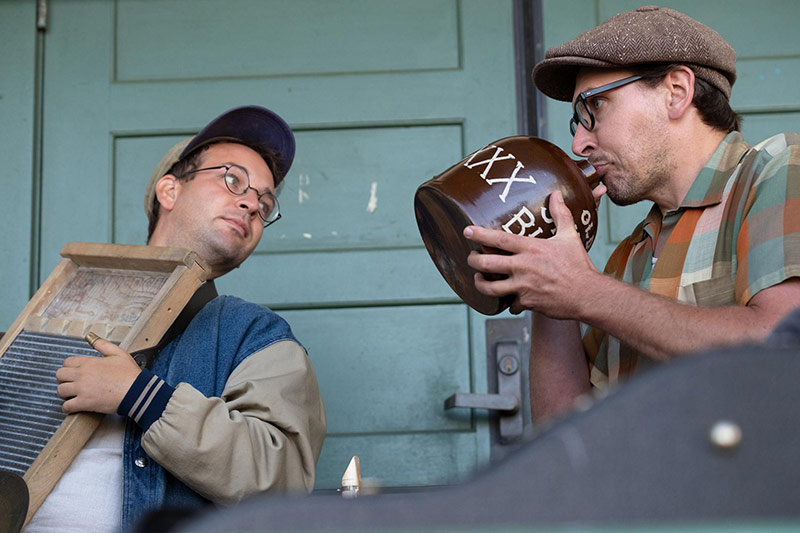
Bring your jug, your banjo, your washboard, your guitar, your mandolin, violin, ukulele, bass, tuba, trumpet, kazoo or your beautiful full-throated voice and let's make some jug band music! The Jug Band will perform their prepared tunes on Saturday before the showcase.
Washboard Chaz Leary - Washboard Percussion
For folks of all levels, whether you want to play polyrhythms at jams, want to add another percussive instrument to your skills or just want to check it out! Chaz will help you get there. Class is always fun, with emphasis on playing with others, soloing and more.
Ethan Leinwand - Piano
Hand Positions and Phrasing - This right-hand focused class is all about the foundations of playing blues melodically. Instead of aimlessly floating up and down the blues scale, we'll find quality hand positions you can lock into, and from those hand positions we'll explore the cadence of blues phrasing.
Ethan Leinwand - Piano
Two-Handed Grooves - This class is focused on rhythms and feels. We'll look at how the right hand can team up with the left-hand bass figures to establish rock-solid pockets.
Jontavious Willis - Songwriting
We will choose a style and compose our own music and lyrics to create a complete song with your personal expressions, through specific techniques, including understanding song structures, chord progressions, and lyrical phrasing.
Beginners
There is no age or skill restriction, however, to get the most out of the workshop, one should be familiar with your instrument and be able to move about on it.
Kids & Teens
Most of our workshops are family events, and we welcome musicians of all ages and abilities to participate.
Info for Parents of Under-18 Participants
If under 18 and participating in the workshop, a parent or guardian over 21 years old must register and accompany the minor. Blues participants under 18 years of age are required to review a Centrum Student Contract. If staying in the dorm a parent or guardian must also stay in the dorm.
Costs
Centrum has a variety of ways to be able to attend our workshops even if you’re on a budget. If you need financial assistance, Centrum has a robust tuition scholarship program awarded on a first-come, first-served; and as-needed basis.
Workshop tuition includes admission to everything including great seats at all public performances.
We have room and board choices to keep your costs as affordable as possible.
A full meal ticket is good for three meals per day starting with dinner on Monday, July 27 and ending with breakfast on Sunday, August 2, 2026.
Tuition, Adult: $675. ($100. non-refundable deposit to hold your place)
Tuition, Youth (Under-18): $575. ($100. non-refundable deposit to hold your place)
Tuition, Gospel Choir: $175.
Tuition, Blues Dance Adult: $400
Tuition, Blues Dance Youth: $300
Room & Board: $870.
Meals Only: $450.
Our new food service provider is locally based Planted. Planted offers nourishing plant-based meals and ingredients that are locally sourced from the Olympic Peninsula. For more info on Planted, visit plantedporttownsend.com.
Those who stay on the Fort Worden campus are provided with private-locking dorm rooms in Buildings 203 and 225 with shared bathrooms. There is late night jamming in Building 204 and all-night jamming in Dorm 203. Dorm 225 will remain quiet, so folks can rest anytime. Choose the jam or quiet designation when signing up for a dorm room.
FAQ
TRADITIONAL BLUES - FAQ
Scholarships
Apply online as you register. Please note that except in rare cases, scholarships are available for tuition only. Centrum requires a $50 deposit of scholarship applicants, which is fully refundable if you are unable to attend.
If you are interested in a work trade position, please contact Mary Hilts at mhilts@centrum (dot) org.
Cancellation/Refund Policy
Full payment is due June 22, 2026. If your full payment is not made at this time, your registration could be canceled; $100 of your deposit is nonrefundable.
Any fee that includes a room: no refunds available after June 22, 2026.
Tuition, meals and/or airport shuttle: no refunds available after June 22, 2026.
Meals
Meals are served at Fort Worden Commons. The first meal is dinner on Monday, July 27; the last meal is breakfast on Sunday, August 2, 2026.
Our new food service provider is locally based Planted. Planted offers nourishing plant-based meals and ingredients that are locally sourced from the Olympic Peninsula. For more info on Planted, visit plantedporttownsend.com.
Blues Travel Tips
Book flights so you:
Arrive at Sea/Tac airport Monday July 27, 2026 - by 1pm Pacific Time, and
Depart Sea/Tac no earlier than 1pm on Sunday August 2, 2026. (Port Townsend is two hours from Sea/Tac on a good day.)
If you’re interested in transportation from SeaTac Airport to Fort Worden, choose the shuttle option for when you register.
The shuttle costs: $120 round-trip or $60 one-way.
Traditional Blues shuttle schedule:
Arrive – Monday, July 27, 2026, pick-up at SEA/TAC airport, 2pm, Pacific Time.
Depart – Sunday, August 2, 2026, depart Centrum at Port Townsend, 9am sharp, Pacific Time.
If you have any more questions about Centrum’s Traditional Blues, please contact Mary Hilts at 360-385-3102, x116, or mhilts@centrum (dot) org.
PERFORMANCES
Workshop tuition includes admission to everything, including the public performances. Performances will be posted in March 2027.
PAST ARTIST FACULTY